
Choosing to Submit to Gravity
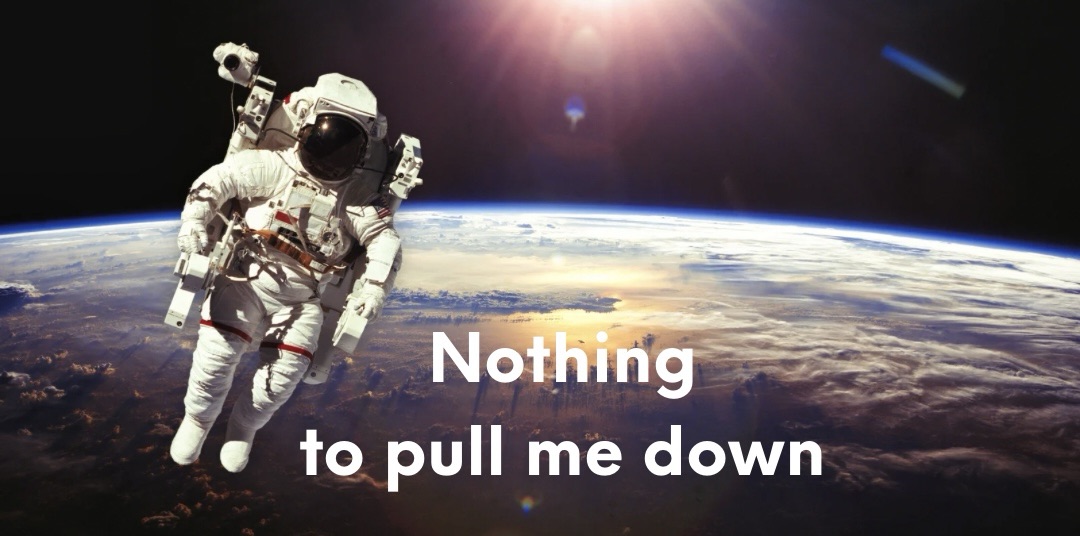
The Launch of Artemis II on April 1st caught my attention. I was a child when Apollo 11 landed on the moon the summer of 1969, and this most recent mission took me back to the wonder I first experienced thinking about space exploration. The Artemis mission was significant for how it is meant to be the first step towards establishing a permanent base on the moon. The astronauts traveled farther from earth than any human ever has before. From there, the plan is to prepare to send humans to Mars. The challenges that must be overcome are enormous.
Going back to my childhood fascination, I determined at age 8 that I was going to learn everything I could about space travel. That lasted for a couple of years. But the information I gathered stuck with me. The most delightful revelation was the weightlessness astronauts experience once they are outside the earth’s atmosphere. Floating! The sense of freedom! Never falling down! Nothing too heavy to pick up! This sounded so fun!
I Need Gravity
It wasn’t till years later that I learned of the negative effects of prolonged weightlessness, also called microgravity. Astronauts can lose their sense of orientation with their inner ear getting confused. Their bones lose density. Their hearts grow weaker as body fluids shift upwards. Fluid buildup in their eyes cause blurry and long-term problems with their vision. Their spines stretch out, causing back discomfort. And their muscles atrophy because they don’t have to work as hard. All these physical maladies are due to one thing: the absence of gravity.
The freedom of not having to submit to gravitational pull, while initially a delightful sensation, has its long-term cost. Another way of looking at it is that humans are meant to live under the, sometimes harsh, pull of this invisible force. We need gravity to thrive physically. The lack of it will be a major problem to overcome as the plans to go to Mars advance.
My conclusion: we need to push against heavy and uncomfortable forces for the sake of our health, and this is not just for the physical body. We need mental, emotional, and spiritual resistance training.
Without It I Don’t Grow
Learning to push past that which is pushing against us is one way to describe what it means to grow and mature. Lifting weights builds strength in our muscles. Problem solving forces our minds to think in new ways. Relational conflict pushes us to explore how others feel, which allows us to grow in empathy and compassion. And wrestling with doubt and uncertainty challenges us to discover reliable places of spiritual rest and hope.
None of it feels fun in the moment. I rarely look forward to working out, thinking deeply about a problem, confronting a relational issue, or spending prolonged time in prayer. There’s always a faint hope that I’ll find a way to get all the benefits of struggling without the pain, stress, and effort. Much of the time, I want to live a gravity-free life – at least in the short-term. It’s easy to complain about the trials of life, thinking that if I could only find a way to not have to struggle I would be so much better off and happier. But, just like our weightless astronauts, if such a condition were possible it would carry a high and long-term cost. True happiness would not be the ultimate result.
The Bible actually has a lot to say about our daily challenges, pressures, disappointments and what they mean for us. For example:
“Count it all joy, my brothers, when you meet trials of various kinds, for you know that the testing of your faith produces steadfastness. And let steadfastness have its full effect, that you may be perfect and complete, lacking in nothing” (James 1:2-4 ESV).
Stability and Joy
Steadfastness is another word for stability. Is it possible that many of us feel untethered and insecure in our lives because we have sought to take the path of least resistance?
Ultimately, we must remember that our Heavenly Father, a very good Father, is committed to the growth and development of His children. He would be less than loving if he took away the pressures and perplexities of our lives simply so we could feel better right now. For it is not merely for this present earthly life you and I have been made for. We are meant for that place where we will live eternally, which takes more preparation than a trip to Mars.
Gravity is our friend. Don’t curse it. Embrace and learn from it. And let it produce what we need to thrive.
Response:
- How is gravity like the daily trials of life?
- What pressure or weight in my life feels too heavy for me to bear? What ways of thinking might God want to change in me that I might see this trial the way He does?
- Where am I choosing the path of least resistance? What is this doing to me? How might I invite God in to that place?
- Jesus, have mercy on me, and give me strength to face my struggles and trials with your Joy.

