
Choosing Straight Paths
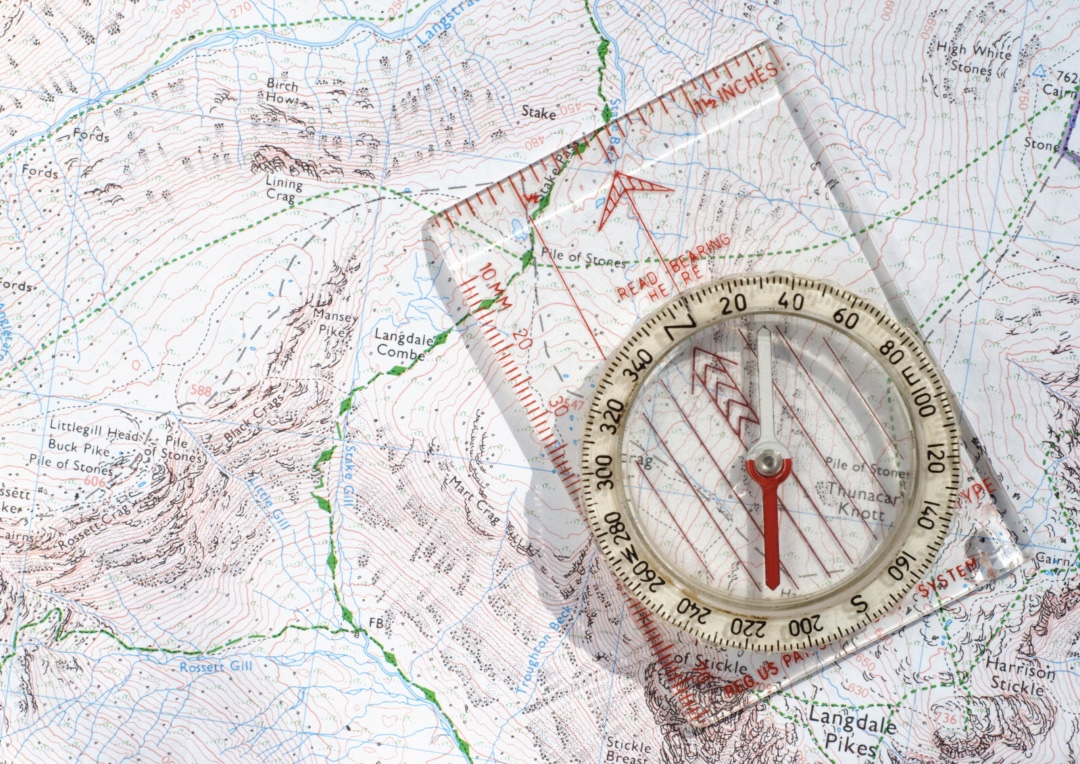
I was on a 10-day camping trip in California’s Sierra Nevada mountains. It was part of my university’s leadership training. We were divided into teams one day with each group receiving a topographical map and a compass. After being shown a spot on the map we were to go, each team was released every 15 minutes to find their way. We would get our next meal when we arrived, and there was a prize awaiting the team with the best time.
An assertive personality immediately took charge in my group, claiming he had used a compass several times when he was a kid. He led us in a straight line across the terrain, northeast, toward our objective. We used the map to roughly calculate how close we were getting, but the compass kept us going in the right direction. We were making great time and congratulating each other that we were going to get the best food and might be setting a record for this exercise.
Then our leader suddenly stopped. To our shock and dismay, we came out of the woods and found ourselves on the edge of a high cliff, a sheer drop off of several hundred feet. Below, we could see where the teams that had left before us were now gathering. But there was no way to descend to them. Oh, how I wanted to be down there at that moment but couldn’t. We had to back track, go around a mountain, and ended up being the last group to arrive, humbly getting the last scraps of lunch. We were then shown how the topographical map held the clues that the path we were on wasn’t going to work. If only we had paid attention to all those tight lines that indicated a steep drop off straight ahead. But we were trusting in our limited knowledge of maps and compasses, not realizing till it was too late how little we really knew.
My Own Understanding
One of the early scripture passages I memorized as a child was Proverbs 3:5-6: “Trust in the LORD with all your heart, and do not lean on your own understanding. In all your ways acknowledge Him, and He will make straight your paths.”
What is it that we are looking for when we seek out a path? Typically, we choose trails or roads according to where we believe they will take us. I know of no one who deliberately gets on a highway that goes in the opposite direction of the end goal. How many of us have gotten lost while confident and even certain that we’re taking the right way? We often get lost by reading, researching, or listening to directions wrongly, or following bad directions that we assume are good. That inner compass isn’t always as accurate as we feel it to be.
Read MoreChoosing Not to Hurt God’s Heart
Scenario 1: An ugly thing
A man claims the sole right to his girlfriend’s attention and affection. He gets heated when she laughs with a coworker or appears to be sharing something personal with an acquaintance. He looks as if he wants to hurt someone when the FedEx delivery guy lingers a little too long at her desk. Observers shake their heads, wondering how someone can be so dense and immature. He should know she does not belong to him. Afterall, that’s not how love is supposed to work.
Or is it?
Scenario 2: A heart-breaking thing
A woman stares at her wedding ring with tears smeared across her cheeks. She replays in her mind that day when he vowed to give himself completely to her and no other for as long as they both would live. But there’s more than enough evidence now to the contrary: numerous late nights at work, passcode changed on his phone. And then there are the multiple sightings she’s been told of—dinner with her. The theater with her. Strolls in the park with her. In a surge of anger mixed with pain, she removes the ring and hurls it against the wall. He should know that he belongs to his wife, not her. That’s how marriage is supposed to work.
Is it really?
Broken Covenant
Jealousy is unpleasant and rightfully condemned in relationships—that is, unless there have been binding vows exchanged. Somehow, a marriage commitment changes things. What starts out as mutual attraction morphs into two people in love. The lovers then commit in matrimony to reserve their affection, intimacy and bodies for each other, uniting their lives in exclusive intimacy. So, how is one supposed to feel if his partner violates this covenant?
Suppose a friend observes my wife spending “extra” time with the FedEx delivery man as he drops off packages. It starts with him lingering longer than necessary at her work to chat. Then he begins leaving little gifts on her desk, including a vase of red roses, that she seems to thoroughly enjoy. Finally, my friend happens to see them together at a coffee shop, holding hands. The friend solemnly approaches me and shares all that’s been observed. What would he think if I responded with, “Yeah, I know. But I’m sure it doesn’t mean much. Besides, she’s old enough to make her own decisions. No big deal.”
I imagine this friend, and anyone else who heard my reaction, would question how much I love my wife. They might also begin to understand, in light of my indifference, why she finds the FedEx man attractive. On the other hand, what would be an appropriate reaction as a husband? Distress? Tears? Anger? My response to unfaithfulness reveals how much I value the relationship in the first place. Jealousy is fitting when what has been pledged to me is given to someone else. And I’m not the only one who feels that way.
Read MoreChoosing to Fear God
Voices. They ring in my ears and shout in my mind. I don’t seem to be able to rid myself of their pressure. They want to be my guide, to instruct me in what I ought to do. They cajole, threaten, rationalize, alarm, accuse and soothe me at different moments. Often the easiest thing to do is submit to their demands. Is this my version of going crazy? Or is it an internal obstacle course that every human navigates? When I stop to honestly examine what’s going on, I find the common thread of these cries to be distress and anxieties about what others think of me. They’re powerful. And they expect to be obeyed.
The closest explanation I find in the Bible labels what I’m experiencing as the “fear of man.” This sensitivity to others’ opinions and voices works to keep me on a certain path. Where this road leads, I have no idea. I just know that it feels intolerable to stray from it. Only later, sometimes much later, I realize it has taken me to places I didn’t want to go. I then see that I was listening to the wrong thing.
“Fear of man will prove to be a snare, but whoever trusts in the Lord is kept safe” (Proverbs 29:25).
The Bible reveals that there is a trap laid for me, and I must be alert. If my ultimate concern when making decisions is appeasing the voices of people (be they inside or outside my head) I will eventually be caught in something that keeps me from going where I truly need to and want to be. And it will be exceedingly difficult to get out of it. How to avoid such a snare? Trust the Lord and not the smooth-sounding or coarse-accusing voices ringing in my ears.
Fear of Man vs. Fear of the Lord
The idea of “fearing man” does not necessarily mean being afraid of people (or the male gender in particular). I understand it to be more about holding certain people’s opinions in high regard, to the point of letting them be the final say in what I do or don’t do. Who are those who have this kind of power in my life?
Read MoreChoosing to Encourage

I was in the third grade when I painfully discovered something about myself. A teacher was giving a math lesson on the multiplication table using a chart with colored geometric shapes. She asked for a volunteer to provide the answer to 3X3, referring to the colored circles on the poster. I raised my hand, was called on, and enthusiastically shouted out, “Nine blue circles!” I knew I had the right answer. But the teacher’s response confused me. “No, they’re purple. What’s wrong with you?” She then asked another child to provide the “correct” answer. Everyone in the class was looking. That was the first time I remember feeling such shame. Something was wrong with me. A year later at an eye doctor’s appointment, I was diagnosed with a type of color blindness. Certain shades of blues and purples, among other colors, looked virtually the same in my world.
On the surface, this shouldn’t have been an event that left a scar. Yet more than 50 years later, it’s still quite vivid in my memory. I forgave the teacher who callously humiliated me a long time ago and have since learned to laugh off most of my color-blind blunderings. But the incident also highlighted for me the difference between merely calling out people’s weaknesses versus calling out courage for them to grow beyond their weaknesses and walk out their destiny.
What’s on God’s heart for me?
There are all kinds of human weaknesses. The Bible is clear that God is merciful, gentle, and kind. Yet He sees our sin and does not wink at it or write it off as merely a mistake. Our alienation from Him stems from the choice made long ago in human history, that people still affirm, to depend on our own understanding rather than on the One who made us. Jesus was sent to the earth to cover our shameful weaknesses and forgive and repair the damage done by our blatant sin. He does a perfect balancing act of truth and love.
So, how might God correct His children in their weaknesses and sin? He’s not afraid to point out the things in our lives that need to be mended or repented of. He loves us, after all, too much to let us remain the same, going around in circles in our brokenness. He desires to give us what we need to move forward. He sees each of us as we were meant to be: sons and daughters, members of His royal family. And that is the eternal future He is always drawing and calling us to.
Read MoreChoosing to Give What I Have

How many plans have been started with grand vision and then abandoned because of how insignificant and underwhelming the idea later felt? My visionary follow-through often struggles. Emotions of discouragement settle in when the glorious things I imagine don’t swiftly materialize.
Not seeing an acorn rapidly sprout into a mighty oak, could easily keep me from watering, nurturing, or even planting it in the first place. Difficulty envisioning a broken, painful relationship restored to something beautiful and lifegiving could keep me from pursuing it, praying for it, and persevering in hope. Even the process of what God desires to transform within me could stall before it starts as old fears, mindsets, and doubts stubbornly refuse to surrender their dominance. It’s so difficult to go all in when what I’m starting with is pitifully miniscule or deformed, carrying no resemblance of what I’m hoping for.
Exercising faith can be so hard.
Yet a tiny, mediocre, or unlikely beginning best describes the inception of so many significant undertakings. Only later is the fully-matured outcome looked upon as grand and imposing. God seems to have no problem starting with something or someone that is tiny, broken, or unimpressive. In the book of the prophet Zechariah, He warns His people to not wrongly judge the initial steps of rebuilding the temple. All they could see was a sadly mediocre foundation. It promised none of the greatness of the awe -inspiring place of worship that Solomon had built.
“Do not despise these small beginnings, for the Lord rejoices to see the work begin . . .” (Zechariah 4:10a NLT).
He Sees it Differently than Us
God was the hopeful One. He was delighted that what He had in mind was being acted upon. He didn’t degrade any part of the project that had begun in faithful obedience. But what do we tend to do when we despise something? Reject it. Neglect it. Disregard it. When we can’t see the significance, we easily turn our attention to other things, and in the process miss what God is doing and what He has in mind for our future and the future of the world.
Read MoreChoosing Real Worship

Some stories in the Bible have struck me as unfair, and at times I have found myself sympathizing with the “bad guy.” Take for example the parable of the three servants who received money from their master to invest while he was gone (Matthew 25:14-30). I can relate to the last servant who was given only one bag of money, compared to the other servants, with one receiving two and the other five. Of course he felt less important than the other two as well as unmotivated, feeling he could never be equal with them. And then the master treated the single-bag servant so harshly. In another version of the story, the master took the one bag of silver from the chastised servant and gave it to the one who already had 10 (Luke 19:11-27)! Unfair! Unfair!
I have, however, come to appreciate the lessons from this parable (like the consequences of comparing myself with others). Yet I’m still uncomfortable with how my natural sense of fairness is rarely affirmed in the Bible. It seems that God is more often interested in what goes on inside a person (the part others can’t see) than what is judged as right or wrong from outside observation. He sees and seeks to deal with a person at a heart level.
For No Apparent Reason
Another one that has bothered me over the years is the story of Cain and Abel (Genesis 4:1-16). The two brothers each brought gifts to the LORD as part of their worship. Cain was a farmer, and so he presented a sampling of his crops to God. Abel was a shepherd who brought a lamb. Makes sense so far. But then God responded by accepting Abel’s offering and rejecting Cain’s. Cain was angry and depressed about it. There’s no further explanation. No explicit commandment that was disobeyed. Cain became so ticked off at his younger brother that he killed him, the first murder. And while of course Cain’s response was evil, some have suggested that God provoked him. Why would God arbitrarily welcome one gift and accept another, especially when both were apparently brought as an act of worship? I have been tempted again to cry “unfair!”
I have determined that my starting point in digging deeper into questions like these must always be that God is good. I therefore presume there is more to the story than I’m seeing as an outside observer. Understanding what is going on here, however, is important because it is the first place in the Bible where worship (bringing gifts to God) is presented. And right from the beginning we’re being shown that there is worship that God accepts and there is worship that He does not accept. Knowing the difference and how God sees this could be important for a follower of Jesus.
Read MoreChoosing Effective Protection

Masks. How effective are they? The debate continues. Since the beginning of the COVID-19 pandemic various coverings have been introduced in the attempt to protect against spreading the dreaded virus. Face shields. N95 masks. Full-body hazmat suits. The latter two fall under the category generally known as PPE: personal protection equipment. The full outfit, worn mainly by frontline medical workers, is quite intimidating when put on, and from what I’ve been told, not very comfortable. Yet it provides people with a greater sense of security, and along the way has likely saved some lives. But, what is the best way for average people to protect themselves? The answer hinges on what an individual sees as the real danger. Depending on the threat, the right protective covering can make all the difference. And it is especially true when battling an unseen enemy.
There are other invisible dangers in this world besides parasitic microbes. Yes, a pandemic is scary when we’re not sure where or how we might be infected. But what about the infestation of “spiritual viruses” that have eternal consequences? Do we as Jesus followers take them as seriously as we do nefarious microorganisms? These non-material adversaries also threaten us daily but assault the soul. They leave people broken, confused and completely lost: lies that are believed; shame and guilt that never leave; doubts; pride; fears; loneliness; despair. We have a spiritual enemy that spreads all this and more.
The Apostle Paul laid out God’s provision for our protection against such insidious infections and attacks in Ephesians 6:10-18. This passage envisions our struggle against unseen forces as a battle. Our survival, well-being and victory depend on our making use of armor that protects us from a hidden enemy intent on our destruction, or at least our ineffectiveness. The PPE that Paul outlines follows what was ancient-Roman battle gear. But the imagery is still applicable for Jesus followers today who are aware that spiritual sickness and brokenness are just as bad as, if not worse than, physical infirmity.
What is God’s Personal Protection Equipment for us?
The Belt of Truth (Ephesians 6:14a)
A lot of Jesus followers still carry debilitating burdens. Much of the baggage is rooted in the disinformation we believe about ourselves, the world around us, and particularly the nature and character of God. The power of a lie is that it feels true, and we then organize our lives around it. And when we rely primarily on what feels right within to determine what is real without, we are in danger of believing the wrong thing about so many life issues. Our lives easily end up stuck in places we never intended or wanted to be.
My baseline for reality must be grounded in something outside myself. Just as the other pieces of a Roman soldier’s armor were supported by and connected into his belt, truth for a Jesus follower is what binds the rest of God’s PPE together. If I am believing false stuff, particularly about my identity and who God is, nothing in my faith walk is secure. Jesus said, “I am the way, and the truth, and the life” (John 14:6). He is the One who must define truth for me—what He says, what He does, what He reveals—regardless what I feel at any given moment. Am I cinching the truth of Jesus more tightly around me? It holds everything else up afterall.
Read MoreChoosing to Take Temptation Seriously

No matter how hard I try, why are some things so difficult to resist? Overeating? Harsh responses to those who correct me? Anxiety about the future? I know how I should respond, what I’m supposed to do, and what I ought to feel. But that rarely gives me what I need to actually do it and never provides what is necessary to truly feel it. No matter what they say, will power alone does not have what it takes to change me and keep me strong against all the types of temptation that push on me.
A 15th Century German-Dutch follower of Jesus named Thomas á Kempis wrote, “The beginning of all evil temptations is a mind not firmly fixed on its purpose…”* I have pondered what this means for quite a while now, and I think brother Thomas has something to teach us. The understanding of my purpose is rooted in the understanding of my identity. Who and what I believe myself to be forms the foundation for all that I do and why I do it. But to make it a bit more complex, it’s not just what I believe about my purpose and identity that is key. The essential point is that these beliefs are what motivate me and they, in turn, shape me. I act according to who and what I interpret myself to be. My identity informs all that I do. How I view myself and my purpose then becomes that which determines how I make all my life decisions.
What’s the Connection?
So, what might be the relationship between temptation and what I believe about myself and my purpose? I have come to see that that which I most identify with makes up the integral part of the blueprint of the desires and feelings I submit to as well as those I resist. If I see myself fundamentally as someone suffering because of my environment and other people’s choices over which I have no control, I will find it difficult to resist the temptation to see myself as a victim. And I will more easily submit to resentment and bitterness, feeling stuck, like I have no other choice.
If, however, I understand myself primarily as one who is loved and valued, I can see more options when I make decisions. My purpose can more easily come into focus by believing there are those who believe in me. What I root my identity in and draw my sense of purpose from contribute greatly to whether or not I am emotionally stable. Purpose and identity are shaped by these mindsets that have captured my allegiance.
The Key to Resisting
Temptation then, particularly what brother Thomas calls “evil temptations,” gets a head start within the mind that is not fixed on its true purpose. And he is speaking here, of course, of the purpose that flows out of what God says about an individual who has embraced His Son, Jesus.
Read MoreChoosing Gentleness

My desire as a boy was to be strong. I was verbally and physically picked on in elementary school. The longing to demonstrate my strength led to a few fights and endless daydreaming of what that day would feel like when I could show the bullies what I had inside me. And there were also the models of “manliness” I was exposed to. Athletic coaches were the most influential. They taught me that to get ahead in sports and in the world, I needed to push harder, and do whatever necessary to be better than the person in front of me. Success would come to those who could overpower the next guy. My cumulative adolescent understanding was that strength was proportional to aggression and determination to subdue anyone who stood in my way. But my feelings of weakness always seemed to be the most powerful things within me. And as a result, I never could sustain any personal campaign of viewing myself as a conqueror.
And then there was Jesus. I prayed to surrender my life to Him when I was a boy. But as I read the Bible stories, I couldn’t escape the feeling that He, as my model, was just as weak as me. Pretty disheartening for a kid trying to figure out the secret of vanquishing abusers and proving to everyone, especially myself, that I wasn’t weak. Jesus, afterall, let Himself be bullied and eventually gave Himself up to be killed on a cross. What hope was there for me?
Quiet Strength
I was several years into adulthood before a new perspective began to take shape in my mind. I noticed in certain people what I came to refer to as “quiet strength.” They didn’t flash muscles or aggressive attitudes. But there was an unmistakable solidness in their convictions, purpose, and courage. There were even the ones who were so secure in their inner firmness that they could prefer and let others get ahead of them without coming across as weak and inferior. How could that be?
Read MoreChoosing What I Love

The word ‘love’ in English is quite pliable. I can say that I love my wife and I love pizza, and most people will not accuse me of reducing my spouse to a mere piece of pepperoni nor seeking to marry an Italian meal. The word can refer to a need (a plant “loves” water) or enthusiasm for a particular thing or activity (my son “loves” the Vikings). It can also describe a profoundly tender affection for another (I love my children). In addition, it can reference almost every positive feeling between the two extremes. This flexibility, however, can sometimes lull us into not thinking about what we mean when we use the word. For a follower of Jesus, care in what we say we love and particularly in what we actually do love has important theological, and eternal, implications.
When I talk about the concept of love with others, I like to point out that it is much more than a feeling. It’s a choice. Most people agree in theory but then get a bit uncomfortable when we examine how we actually apply the term. When we use phrases like “falling in love,” or “falling out of love” there’s no getting around the idea that we’re talking about an emotion that can be there one moment and gone another. Such usage leaves the impression that we are helpless victims to this thing we call love. So much of today’s relationships, romantic and otherwise, are centered on what we feel about a person at any given moment, which is in constant flux. And that stirs some deep insecurity in relationships, not to mention the cynicism associated with the word love.
A More Durable Understanding
The biblical presentation of love, however, talks about something more reliable than good and affectionate feelings. How else should we interpret Jesus’ command to “love one another” (John 15:12)? He tells His followers to do it, no qualifications or exceptions. Most people realize that feelings cannot be commanded to come or go. Instead, feelings tend to follow our choices and what we focus our attention on. The love Jesus is talking about, therefore, is something we choose to do. It’s a matter of obeying Him.
A definition I find helpful for this understanding of love is choosing to give the highest good to another. It’s what God does for us and what he tells us to do for others. Sometimes the words that carry the meaning of love the best are I still choose you.
Read More Choose This Day