
Choosing a Different Kind of Wealth

A couple of years ago, I had a long layover at an Australian airport. While waiting in line to pay for a snack, the man in front of me haggled with the cashier over his purchase. He wanted to use Bitcoin to buy a candy bar. The woman ringing up the sale stated multiple times that they didn’t accept such currency. The man, for his part, went on to give a somewhat lengthy lecture on the need for them and everyone to get with the times because cryptocurrency is the future. Besides being irritated by the delay he caused, I remember thinking how foolish and out of touch the man sounded. In my limited understanding at the time, cyber money was in the same category as Monopoly money – worthless for any practical purpose.
I don’t know a whole lot more today than I did back then. But I do now believe that it’s unlikely that cryptocurrency is going away. It stirs controversy and polarizes investors because it is challenging the way we understand money. And at an even more fundamental level, it is calling out how value is determined. Rather than continuing to accept the traditional system where governments and financial institutions largely control currency, crypto investors are betting on the expanding appeal of a decentralized scheme where no single person or group can manipulate value. It’s sounding more interesting even if it still seems a bit strange.
What makes something valuable?
Where value comes from is a question to ponder. Cryptocurrency and NFT’s (non-fungible tokens) after all are digital. There is nothing to hold in your hand unless you cash-in through a broker of some kind. A market for NFT artwork is also developing. Unique digital NFT collectibles (Google “Bored Apes”) are being sold for thousands and even millions of dollars.* And all this cyber stuff attracts investors in the same way an original Van Gogh or Rembrandt does. It’s not the material itself that holds intrinsic worth but what it represents: beauty, status, freedom, decentralization.
Value is determined by what people are willing to pay for any given item or service. Though the dollar amount may fluctuate with the needs, interests, and moods of people, value itself is a very real entity, even if it is mysteriously intangible, fluctuating in strange ways. It can cause the price of a baseball to shift from $8.99 to $752,467.20 in just a few seconds because a certain person hit it over a fence.**
Read MoreChoosing to NOT Forget

Last month, on December 7th, a day was remembered that many of the past generation vowed to never forget. Eighty years ago, the Empire of Japan launched a surprise aerial attack on the American naval base in Honolulu, Hawaii. In the harbor, 21 American ships were sunk or damaged, leaving over 2400 American servicemen killed that morning and more than 1100 wounded, many while they were still in their beds. The next day, the U.S. Congress declared war on Japan, and America entered World War 2. It would be a terribly bloody four years, filled with experiences that many people would want to forget.
As with the beginnings of all wars, the Pearl Harbor attack is a sobering and unpleasant event to reflect on. I am particularly drawn to remember it, however, because my uncle was stationed there at the time. As a child I heard his stories of driving a military jeep while trying to outmaneuver Japanese fighter planes strafing the roads around the naval base with their machine guns. Meanwhile his newlywed bride was down at the harbor’s edge pulling sailors from the flames of the oil-coated water. It was supposed to have been a quiet Sunday morning, the first day of their honeymoon. These and other descriptions burned deep impressions into my mind.
Besides the historic value, there are other reasons for stopping to reflect on events from days gone by. Philosopher George Santayana said, “Those who cannot remember the past are condemned to repeat it.” This aphorism rings true in a general sense, especially for those of us who consider ourselves history buffs. The illogical, self-centered, damaging enterprises and policies that people and governments repeat over and over is difficult to fathom. It’s as if we’re trying to NOT learn.
Read MoreChoosing the Help That’s Offered

It’s a nameless, forgotten movie from my childhood. But one scene has remained etched in my mind for decades. Perhaps it’s a composite of multiple movies. An individual, walking through a trackless jungle, steps into quicksand. He tries to work his way out, but the more he moves the deeper he sinks. Fortunately, he has a companion who avoided the trap and is able to throw the sinking man a rope or long stick from the edge of the quagmire and pull the friend to safety.
Why has this episode remained so vivid in my memory? It’s probably due to the sheer terror that comes with imagining being so powerless in such a deadly situation. For years afterward, I was on constant lookout in my wanderings through woods or rural areas for any miry hole that I could stumble into. Afterall, I might not have someone there to pull me out.
Helplessness is a terrible feeling. The inability to move out of an unpleasant, restrictive, or toxic situation can eventually squeeze hope out of a person. Whether it’s life-sucking addictions, character-crushing jobs, soul-suffocating relationships, death-dealing circumstances, or merely mind-numbing boredom: to be unable to lift oneself out of a cheerless pit is cause for all categories of despair. How does one find relief and freedom?
Read MoreChoosing to Leave the Past Behind

The new year is upon us, and that means resolutions! Many of us are making promises to ourselves to initiate changes in our lives. I have heard mixed reviews regarding the effectiveness of such commitments. The vast majority of us give up on the pledges made on January 1st before the month is even over. Vows to lose weight, get in shape, spend more time with family, or stay off social media start out strong but lose steam as old habits reassert themselves. But there are pathways to success. So don’t give up trying!
The past is often our enemy when it comes to making healthy changes for the future. Bad habits seem to have deep roots. Patterns of past failures and discouragement push their way to the forefront and work to derail our good intentions. How realistic is it to simply forget the past and move into a brighter tomorrow? If we’re trying to do it with pure will power, the chances for success are not very good.
A powerful phantom of the past is guilt.
The weight of yesterday’s mistakes and sin does not just drop off our shoulders because we decide we want it to. It can be a burden that is never lessened. Or like quicksand, it makes us feel as if we are being constantly sucked lower and lower. Either way, it is a real force that keeps many from experiencing freedom and making positive changes for the future.
Why Guilt?
First of all, it’s not all bad. There are things that I have done where it was appropriate that I felt guilt afterwards, like taking something that didn’t belong to me, speaking harshly for selfish reasons, manipulating another’s emotions to get what I wanted, or betraying another’s trust. Guilt is good when it leads me to humbly acknowledge my sin and make appropriate restitution. Yes, it’s painful. But all pain isn’t bad. Discomfort that addresses bad behavior has a life-giving purpose.
Read MoreChoosing to Move Forward

A chance for new beginnings and making life improvements. A clean slate to start over. That’s what so many of us long for and what the new year seems to offer. The tradition of making New Year’s resolutions has been popular for quite a while. There’s evidence that the ancient Babylonians more than 4,000 years ago were using the beginning of their new year to make promises to their gods. The Romans adopted that practice, as well as Medieval knights renewing their chivalric vows. Later, Protestants started holding New Year’s Eve watch services to pray and read scripture as they committed themselves to renewed efforts of living out their Christian faith.*
Today, New Year’s Resolutions are pretty much a secular practice. Rather than seeing them as vows to a deity, most people now make promises to themselves. From what I’ve read, around 45% of Americans make resolutions at the beginning of each year. However, 80% of those who do, give up after the first week. Around 8% of those who take that first step at the beginning of the year end up achieving their goals. It appears that few of us are able to keep the promises we make to ourselves.
New Habits are Hard
Why are personal goals so often not met? For one, we tend to focus on the areas of our lives where we know some kind of change is needed. But we feel little, if any, motivation to actually ‘pay the price’ and do anything about it. I look at myself in the mirror and decide I need to lose some weight. But my immediate alarm over my poor shape recedes when I see the plate of Christmas cookies sitting on the table. Motivation is the engine for change. Tapping a reason for losing weight that stirs something more than the momentary satisfaction of looking good in the mirror is an important key. I need to know myself and what makes me tick.
Another reason personal goals are so regularly abandoned is that we try to go at them alone. Encouragement, support, and accountability are necessary for even the most independent souls. Involving others increases the likelihood that we’ll actually follow through.
And what’s the result of setting a goal that you don’t really want to tackle with no plan for support or accountability? Failure. Though it can be a powerful teacher and motivator at times, for many of us lack of success just makes us not want to set anymore goals. We easily rationalize and settle.
Read MoreChristmas: Choosing Small Beginnings

Speculations on the beginning of the universe fascinate me. There is, of course, the Big Bang Theory (not the television show). It is the most commonly known hypothesis, proposing that all existing matter was at one time compressed into a tiny, infinitely dense speck called a singularity. It then exploded (what caused the blast is unclear), sending stars and planets shooting across infinite space. At least that’s the theory. It continues to be reshaped, questioned, and for some, disregarded as additional information is collected and new theories proposed.
But the idea that something of such great magnitude as the universe could be squeezed to a point infinitely dense and minute is what I find so interesting. Is that possible? And if true, what might it have to say about the God who brought the universe into existence?
The study of nature and physics, I believe, can sometimes confirm and reveal the thoughts and values of our Creator. As I get to know my God, I have a hard time believing that anything He designed and made was random. Jesus relates water to the life-giving work of His Spirit. He also likens the consuming of bread (or any food) to be like the spiritual nourishment He provides for those who depend completely on Him. Wind and breath are equated with the work of the Holy Spirit. Many concrete physical realities are used to help us begin to understand abstract spiritual truth. The problem, of course, is that my brain is too tiny to take in all the ways creation reveals His work, His values, and His character. Yet it’s all there in front of us. And every once in a while scientific study scratches below the surface.
Big God, Little People
Going back to the universe. We have to believe in a mighty God if we understand that He created everything that exists. But why would a being so mighty and infinite in capacity be interested in things that are so limited and tiny? The writer of Psalm 8 appears to have wondered the same thing:
“When I look at the night sky and see the work of your fingers – the moon and the stars you set in place – what are mere mortals that you should think about them, human beings that you should care for them?” (Psalm 8:3 NLT)
The Almighty, Majestic, Heavenly Father takes an interest in such infinitesimal and troublesome creatures as us. By the standards of human logic, there’s no satisfying explanation for why. And yet our entire faith rests on the mystery of HE WHO IS SO GREAT AND ETERNAL choosing to give and sacrifice for something so apparently minuscule and temporal as a human.
And then there’s Christmas.
Read MoreChoosing to Open My Eyes
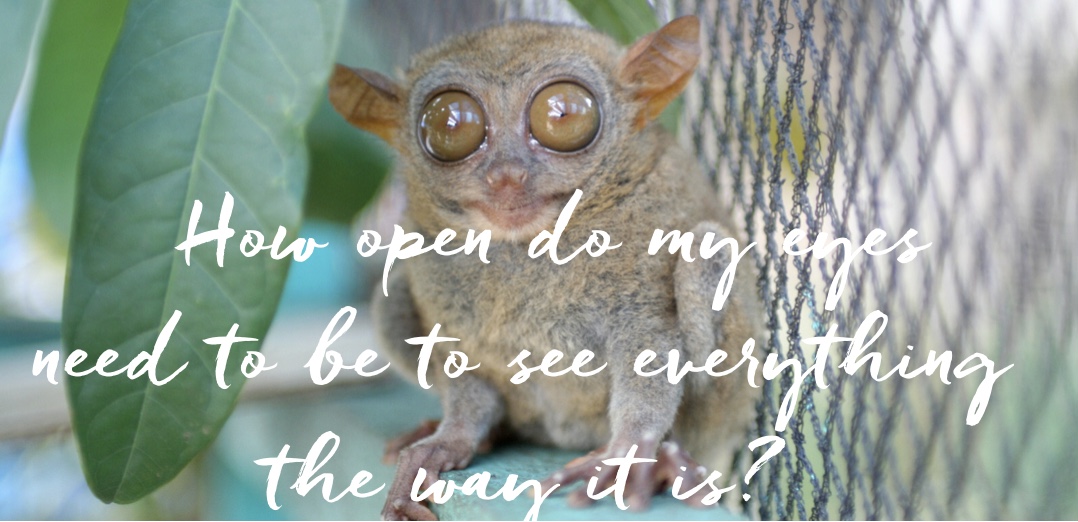
When I realized what was next to me, I flattened myself against the side of the house in shock. I kept telling myself that this couldn’t be real. Things like this don’t happen here.
My cousin and I had started a window-washing service as our summer job between college semesters. We figured we could make easy money with our pails and squeegees catering to the affluent Los Angeles suburbs. I didn’t mind the washing part. But knocking on doors and soliciting potential customers stretched my non-salesman personality.
A particular experience remains my reason for making that the last summer of door-to-door sales for me. In a very nice Southern California neighborhood, a woman invited me to walk around the outside of her house to calculate an estimate. The area surrounding the back patio was cluttered with assorted items, but my focus was on counting windows. I navigated clay pots, garden tools, patio furniture and other debris scattered through the yard. At one point I glanced down at my feet that were almost touching an inflatable pool toy. The life-size “toy” alligator opened its eyes and turned its head toward me.
Positive that my heart stopped beating, I dropped my clipboard and pressed my back against the wall, unable to make a noise. Looking up for help, I saw another long reptilian figure moving across the grass toward me. The scream that finally found its way to my throat was cut short when the woman of the house popped her head out of the patio sliding-glass door and said, “I forgot to tell you about my pets.” Oh really!?
In the end, we got the job. But when it came time to wash the windows, I did the inside and let my cousin brave the outside. We were college students, afterall, and couldn’t pass up the money.
Blind
Why do we sometimes not see what is right in front of us? The surface answer is that we’re not paying attention. But in many cases, especially for myself, it has to do with not seeing what I’m not expecting—like seven-foot alligators in the LA suburbs. The adage, “I’ll believe it when I see it” is only true part of the time. For many it’s just as true to say, “I’ll see it when I believe it.” Beliefs and sight are closely tied together. Which one comes first is hard to say for sure.
In Matthew 6:22-23 Jesus made a curious statement about our eyes and what they take in: “Your eye is like a lamp that provides light for your body. When your eye is healthy, your whole body is filled with light. But when your eye is unhealthy, your whole body is filled with darkness. And if the light you think you have is actually darkness, how deep that darkness is!” (NLT). What are “healthy” and “unhealthy” eyes? I understand Jesus to be talking about a condition in which someone is blind to what’s really in front of him. The danger for this person is that he believes he’s seeing everything as it truly is. But the “light” (or information) he thinks he has is really nothing more than “darkness.” People get lost as well as hurt themselves and others when they walk around in the dark without some kind of light. Another word for this condition is deception.
Duped
So, how do I know I’m being deceived? That’s the problem—I don’t. Deception means I believe I’m seeing everything clearly, but my “light” is actually “darkness.” It all feels true and fits what I believe about reality, so I don’t question it, even though there may be things about it that I don’t like. Ultimately, there is only one way to break the grip of deception in my life and gain a “healthy” eye. I have to change what my sight is focused on. And to do that I need information or “light” from outside myself that can direct me where to look. The overall message of the Bible is clear: left to myself I am lost; I need the external Light of a Savior. And I must be willing (i.e. humble enough) to recognize that Jesus Himself is the One who came to illuminate my reality.
Jesus had interesting exchanges with a Jewish political/religious group called the Sadducees. They believed that only the Torah (Genesis, Exodus, Leviticus, Numbers and Deuteronomy) were inspired. They also denied pretty much everything supernatural. This blotted out any belief in angels, demons, life after death, resurrection, etc. (which sounds like a few people I’ve rubbed shoulders with). They were also the group that controlled the position of the high priest at that time. And maintaining political power was very important to them.
In Mark 12:18-27, a group of Sadducees approached Jesus with a scenario on which they wanted him to comment. Their real intent was to trap Him into saying something that would discredit his teaching and make Him look ridiculous as He defended belief in an afterlife. But Jesus turned the table on them, and they were the ones who got schooled (read the whole story). Jesus made it clear in verse 24 what He saw as the Sadducees’ problem: “Your mistake is that you don’t know the Scriptures, and you don’t know the power of God.” Their beliefs had prohibited and blinded them from seeing what was right in front of them. They had the Scriptures, but they weren’t trusting them or letting them unveil the fullness of the God they claimed to believe in.
Jesus basically was telling them that they needed to open up and receive something from outside their own comfortable belief system. Their eyes were focused on the wrong things, like holding onto power and being proven right. And thus, they were “mistaken” or deceived into living their lives according to the “light” that convinced them that this present world was all that mattered. Their “light” was “darkness.”
Modern-Day Sadducees?
Deception is a real problem today on multiple levels. It is so easy to find information (“light”) on the internet that fits what I already believe. Fact-checking by researching multiple sources is so inconvenient that few of us do it. We see and take in only what confirms our presumptions. And then we immediately share it, never considering that we might be thoughtlessly spreading “darkness.” But as bad as social and political misinformation can be, there is something worse.
We may be believing lies about God. Many still cannot see the loving and righteous character of our Maker. And it’s our beliefs about Him that determine how we view Him as well as how we live our lives. Do I see God as the Heavenly Father He has revealed Himself as? Or does it feel true that He’s far away, uninterested, too busy, weak, unjust or simply not good?
And there are also questions about how we view ourselves, others and the world around us. Do what our eyes see line up with what God has revealed in the Scriptures? Like the Sadducees, might Jesus be telling us, “Your mistake is that you don’t know the scriptures or the power of God”? Unfortunately, any wrong perspectives we carry feel true, and that is what gives them their power to deceive. We can never know or see the truth about how God loves us and embraces us as His sons and daughters unless we choose to listen to Him. A source of “light” outside ourselves that can fill our “whole body” is necessary to show us the truth we cannot see on our own. And God has provided this illumination through His Word.
Realigned Focus
By asking Him to open your eyes, pull back the blinds to see what He sees, your beliefs can change to align with Him. Believe when His word says He is good so you can see His goodness. You don’t have to step on a hungry reptile to wake up to what’s around you. God is calling you to believe what He has said and experience His power so you can know what’s true through His eyes.
Jesus told Thomas, “You believe because you have seen me. Blessed are those who believe without seeing me” (John 20:29 NLT). There is a special blessing for us who trust in God’s goodness and power even when at the moment we can’t see either one.
I want that blessing.
Response:
- What are some ways I have been tricked or deceived in the past? What kind of information would have helped me see through the deception?
- How have my beliefs affected what I see and don’t see about God? Others? The world?
- In what areas of my life might I not want to see things the way God sees them? Why?
- In what areas of my life do I need a different perspective? How badly do I want to see things differently? How might God already be trying to show me His perspective?
- Jesus, what do you want to show me about the Scriptures and the power of God?
(Edited and reposted from May 25, 2020)
Choosing Effective Rest

Few things feel better than a good night’s sleep. To wake in the morning feeling energized and refreshed is one of the best ways to face whatever circumstances waiting for me that day. But why do I seem to do almost everything there is to sabotage ideal nighttime rest?
I stay up too late and then get up too early to allow myself the seven to eight hours needed. I stare at electronic screens up until crawling between the sheets. I end my day thinking and worrying about work or ministry problems, relationship issues, family concerns, politics, and how I would like to drop 15 pounds. Any of these things have the potential of setting my mind and stress into motion so that rest eludes me. Why is quality rest something I so strongly desire yet so often fail to experience?
A simple internet search leads me to a multitude of reasons rest and sleep should be made a priority. Here’s a few:
- It boosts the immune system—our bodies produce infection-fighting antibodies during our sleep.
- It improves memory—while we sleep, our memories and skills are shifted to more permanent parts of our brains.
- It restores and invigorates—the cells of our bodies are repaired and re-energized while we sleep.
- It stimulates creativity.
- It helps manage weight—yes, you read that right!
- It improves concentration and productivity.
- It slows the aging process—WOW!
God Values Rest
In Genesis 2, God is described as resting after He made the world. The completion of creation was so significant to Him that He declared the seventh day to be holy and a day of rest. It has always seemed odd to me that the Almighty God who I was taught never grows tired or weary needed some down-time to recover from His work.
Huh?
Read MoreChoosing Sweetness

As a kid, there were certain old people I avoided. They were the kind that didn’t seem to have the capacity to endure the messiness and clumsiness of children. They couldn’t see the intentions of little ones when something got spilt or broken. They were the kind who yelled or growled when there was a bit too much noise. They complained when kids walked on their lawn, left fingerprints on their windows, created stains on the carpet, or ran through hallways in church. Unfortunately for me, I couldn’t always avoid them. At times it felt as if they were stalking me, pointing accusing fingers, wishing aloud for the good ol’ days when children were seen but not heard. In general, they lamented how poorly they were treated by almost everybody. It wasn’t till I got older that I learned a good descriptor for this type of person: bitter.
Getting older myself, I now sometimes wonder what can keep me from becoming like one of those crotchety elders whose company I so much wanted to escape. It’s not as simple as I once assumed. For I can feel within myself attitudes or thoughts that remind me of those despised ancient ones. When I feel irritated that those around me don’t see things the right way – the way I do. When I want to blame the world’s messes on all the people out there who know nothing but at the same time overlook my own ignorance. When I don’t want to let go of the hurt and offenses committed against me and those I care about. When I feel like God has forgotten me and doesn’t seem to be concerned if I hurt or wallow in bewilderment. When pain and confusion get the better of me and all I want to do is spill it out and force others to feel it too.
The hard truth: I have great potential for becoming a bitter old man.
It Can Take Over
No one turns into a rancorous, vitriolic, distasteful human being overnight. It seeps into an individual little by little, choice by choice. I know of no one who has made it their life ambition to become that person everyone wants to avoid. But bitterness, nevertheless, shows up and produces more fruit like itself until it takes over and rules a personality.
Read MoreChoosing to Give Thanks

I am afflicted with a condition that I understand many men have. I often cannot see what is right in front of my face. The can of soup I’m looking for in the pantry mysteriously disappears when I go to retrieve it. I’m perplexed and frustrated. And then my wife steps in and produces it out of thin air. How is that possible? To my embarrassment, it isn’t a mere coincidence.
Somehow, she has the ability to see what is really there. I look, and if it is not where I imagined it should be, or if it is a different color or shape than I assumed, or not moving, I’m afflicted with a curious blindness. Items in plain sight are cloaked. I experience this while searching for socks, medicine, keys, and books more often than I care to admit.
But I’ve come to see that it also is a condition that affects my soul.
Blind to What I Have
I am naturally programmed to focus my attention on what I can’t see—that is, what is not immediately in my grasp. My mind is alert to comparing my status, career, possessions, education, relationships, experiences to those around me. More often than not, however, I come out on the short end. What I have doesn’t seem enough and I become agitated. This blinds me to what I do possess. I don’t see what I really have. And sometimes I don’t have to compare myself to anyone; I just see everything in my life and around me that’s wrong.
When our family has a financial need, my tendency is to then focus on the many other things that are not ours. Something breaks in our house that I cannot immediately afford to repair, and my eyes then zero in on the walls that need to be painted, the deck that needs to be sanded and stained, the roof that will soon need to be replaced and I feel myself slipping into depression. What I fail to take in and savor in those moments is that we’ve actually been blessed with a house to live in!
What a terrible sickness this is!
Read More Choose This Day