
Choosing to See Beyond What’s in Front of Me

How many plans have been started with grand vision and then abandoned because of how insignificant and underwhelming the idea later felt? My visionary follow-through often struggles. Emotions of discouragement settle in when the glorious things I imagine don’t swiftly materialize.
Not seeing an acorn rapidly sprout into a mighty oak, could easily keep me from watering, nurturing, or even planting it in the first place. Difficulty envisioning a broken, painful relationship restored to something beautiful and life-giving could keep me from pursuing it, praying for it, and persevering in hope. Even the process of what God desires to transform within me could stall before it starts as old fears, mindsets, and doubts stubbornly refuse to surrender their dominance. It’s so difficult to go all in when what I’m starting with is pitifully minuscule or deformed, carrying no resemblance of what I’m hoping for.
Exercising faith can be so difficult.
Yet a tiny, mediocre, or unlikely beginning best describes the inception of so many significant undertakings. Only later is the fully-matured outcome looked upon as grand and imposing. God seems to have no problem starting with something or someone that is tiny, broken, or unimpressive. In the book of the prophet Zechariah, He warns His people to not wrongly judge the initial steps of rebuilding the temple. All they could see was a sadly mediocre foundation. It promised none of the greatness of the awe -inspiring place of worship that Solomon had built.
“Do not despise these small beginnings, for the Lord rejoices to see the work begin . . .” (Zechariah 4:10a NLT).
Read MoreChoosing to Stand

Many years ago I read a slim little book by a Chinese pastor known as Watchman Nee. It was a study of of the Biblical book of Ephesians. It is called Sit, Walk, Stand, and I have referred to it many times since.
SIT
He points out that the first three chapters of Ephesians focus on what God has done for us through Jesus. We are told that God predestined us to be adopted by Himself through Jesus (Ephesians 1:5). That He’s given us the Holy Spirit as a guarantee of our future inheritance until we acquire possession of it (Ephesians 1:13-14). That we have been saved by grace through faith (Ephesians 2:8). That we are no longer strangers and aliens but members of God’s household (Ephesians 2:19). That Christ is ready to dwell in our hearts (Ephesians 3:17). And these are a mere fraction of what all is stated to be ours in the first three sections.
Pastor Nee calls these the SITTING chapters. All that God has done for us is laid out, and we simply have to learn to rest or SIT in what has been set into motion. There are really no commands or directions given to obey here. We are called to believe and trust — which of course is not always easy.
Read MoreChoosing to Seek the Highest

The word ‘love’ in English is quite pliable. I can say that I love my wife and I love pizza, and most people will not accuse me of reducing my spouse to a mere platter of pepperoni nor seeking to marry an Italian meal. The word can refer to a need (a plant “loves” water) or enthusiasm for a particular thing or activity (my son “loves” the Minnesota Vikings). It can also describe a profoundly tender affection for another (I love my children). In addition, it can reference almost every positive feeling between the two extremes. This flexibility, however, can sometimes lull us into not thinking about what we mean when we use the word. For a follower of Jesus, care in what we say we love and particularly in what we actually do love has important theological, and eternal, implications.
When I talk about the concept of love with others, I like to point out that it is much more than a feeling. It is a type of choice. Most people agree with this in theory but then get a bit uncomfortable when we examine how we actually apply the term. When we use phrases like “falling in love,” or “falling out of love” there’s no getting around the idea that we’re talking about an emotion that acts independently of our will. It can be here one moment and gone another. Such usage leaves the impression that we are helpless victims to this thing we call love. So much of today’s understanding of relationships (romantic and otherwise) is centered on what we feel about a person at any given moment. All the fluctuation in our feelings can stir up deep insecurity in relationships, not to mention crass cynicism. Love does not seem very stable.
A More Durable Understanding
The biblical presentation of love, however, talks about something more reliable than good and affectionate feelings. How else should we interpret Jesus’ command to “love one another” (John 15:12)? He tells His followers to do it, no qualifications or exceptions. Most people realize that feelings cannot be commanded to come or go. Instead, feelings tend to follow our beliefs, our choices, and what we focus our attention on. The love Jesus is talking about, therefore, must be something we choose to engage with regardless what we may or may not feel. It’s a matter of obeying Him.
A definition I find helpful for this understanding of love is choosing to give the highest good to another. It’s what God does for us and what he tells us to do for others. Sometimes the words that carry the meaning of love the best are I still choose you.
Read MoreChoosing the Gift of Shalom

I once read an article by an atheist describing the serenity he felt as he overlooked a beautiful valley while drinking a cup of coffee. The point he was trying to make was that Christians do not have a monopoly on peace. He was irritated with the claim that religion is somehow necessary for a person to have a sense of tranquility. His way of refuting this was to recount the many times he had experienced an internal quiet and harmony with nature and others without any acknowledgement of the divine. His conclusion was that a belief in God is not necessary to feel peaceful. And after reading all that he had to say, I had to agree with him.
But is there more to it than what he was experiencing?
Jesus followers often talk about the peace that comes over us after surrendering our lives to Him. It’s often part of what we felt was missing in our lives. And it makes sense. Afterall, Jesus the Messiah is called the Prince of Peace (Isaiah 9:6); one of the fruits of the Spirit is peace (Galatians 5:22): and peacemakers will be called the children of God (Matthew 5:9). But what exactly is this quality that is promised all throughout the Bible?
Shalom
The biblical Hebrew word is still used by many modern Israelis as a greeting. Its general sense is that of holistic goodness. The Old Testament presents shalom as a multidimensional quality that includes physical, psychological, social, and spiritual wellbeing. God’s shalom thus adds up to an overall sense of inner security for the person who experiences it, which imparts many benefits. One example is stated in Psalm 4:8. “In peace [shalom] I will both lie down and sleep; for you alone, O Lord, make me dwell in safety” (ESV). Biblical peace appears to be something that is not created by the individual but comes from God. It also appears that trusting Him is what activates His shalom in our lives.
Read MoreChoosing to Remember Who I Am

No matter how hard I try, why are some things so difficult to resist? Overeating? Harsh responses to those who correct me? Anxiety about the future? I know how I should respond, what I’m supposed to do, and what I ought to feel. But that rarely gives me what I need to actually do it and never provides what is necessary to truly feel it. No matter what they say, will power alone does not have what it takes to change me and keep me strong against all the types of temptation that push on me.
A 15th Century German-Dutch follower of Jesus named Thomas á Kempis wrote, “The beginning of all evil temptations is a mind not firmly fixed on its purpose…”* I have pondered what this means for quite a while now, and I think brother Thomas has something to teach us. The understanding of my purpose is rooted in the understanding of my identity. Who and what I believe myself to be forms the foundation for all that I do and why I do it.
But to make it a bit more complex, it’s not just what I believe about my purpose and identity that is key. The essential point is that these beliefs are what motivate me and they, in turn, shape me. I act according to who and what I interpret myself to be. My identity informs all that I do. How I view myself and my purpose then becomes that which determines how I make all my life decisions.
What’s the Connection?
So, what might be the relationship between temptation and what I believe about myself and my purpose? I now understand that what I most identify with is what makes up the blueprint of the desires and feelings I submit to, as well as those I resist. If I see myself fundamentally as someone suffering because of my environment and other people’s choices over which I have no control, I will find it difficult to resist the temptation to see myself as a victim. And I will more easily submit to resentment and bitterness, feeling stuck, like I have no other choice.
If, however, I understand myself primarily as one who is loved and valued, I can see more options when I make decisions. My purpose can more easily come into focus by believing there are those who believe in me. What I root my identity in and draw my sense of purpose from contribute greatly to whether or not I am emotionally stable. Purpose and identity are shaped by these mindsets that have captured my allegiance.
Read MoreChoosing a Different Perspective
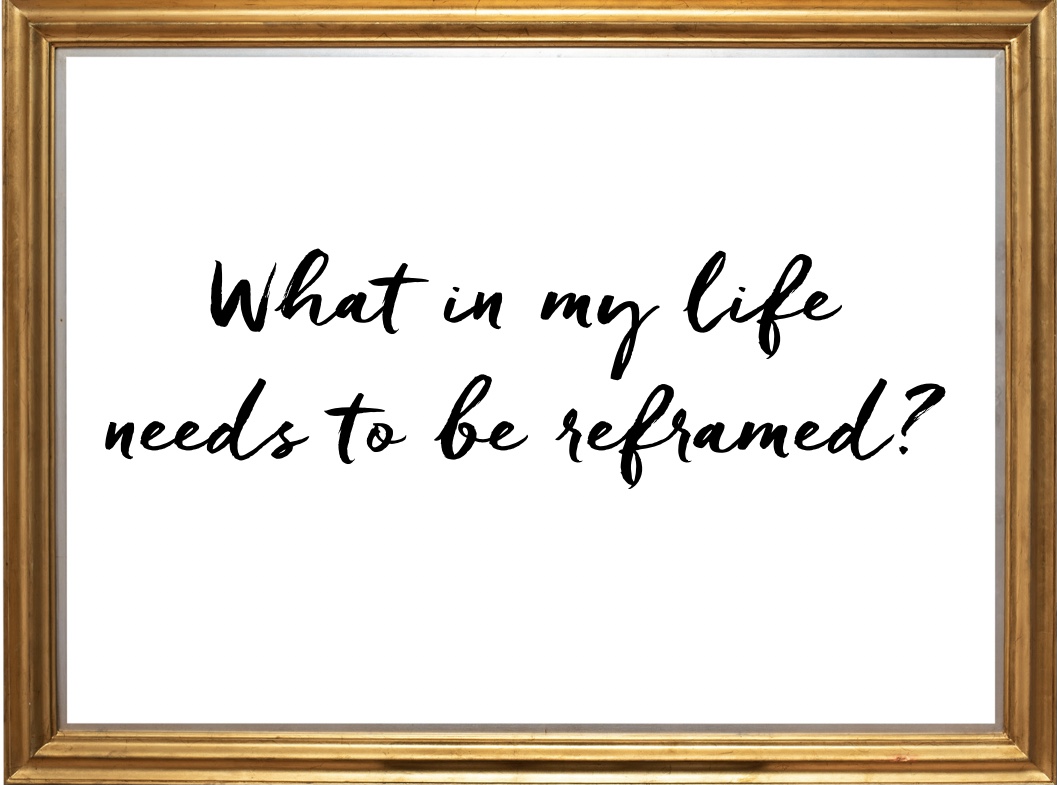
Perhaps you’ve seen the presentation before. Someone asks you to tell them what you see on the screen. You look, and there is a single black dot in the middle. That is all. The presenter then asks if there is anything more. Once you confirm that the tiny black speck is the only thing there, the presenter then asks about all the white space surrounding the dot. Oh! You never thought about considering that as part of what was there. Now you’re looking at the screen differently.
This is just one of a million ways to introduce the idea of “reframing.” It’s the act of seeing a situation or problem from a different perspective. It can be a very helpful instrument for change. Therapists use it. Life Coaches use it. Leaders use it. And many individuals have turned it into a personal problem-solving tool. The goal is always to find a solution or way forward when confronted with the feeling that you’re limited or stuck.
Viewing circumstances from a different angle will almost always loosen up stiff thinking patterns. In the example above, our minds tend to put a “frame” around the one tiny particle at the center of the screen, and that is all that is consciously acknowledged. A new perspective is gained when the “frame” is stretched outward to encompass the entire screen. Awareness of new space opens the door for new possibilities and, for any potential problem, new solutions. We also see that the dot (or problem) is actually quite small when a new frame opens our eyes to a much larger context.
A New Perspective
I learned to do this long before I knew there was a name for it. As I was hit with problems, fears, and hurts when I first joined YWAM, a wise voice often asked me, “What does Jesus want to teach you in this, Jeff?”
Read MoreChoosing to Care for that which Belongs to God
A few years back, some friends asked if I would keep their car while they spent a few months working in Asia. I could use it as a second vehicle as long as I took care of it. It ended up being a great deal for us as a family who had only one vehicle. It was more sporty than our minivan, a stick-shift, and a lot of fun to drive. Ironically, I was accused of giving it more tender-loving-care than our own vehicle – checking the oil at each fill-up, regular car washes, vacuuming the inside. Why? Though I enjoyed it for the season as if it was my own, I knew it was not really mine. I wanted my friends to continue to trust me and think of me whenever they had something else of importance that needed watching.
The old-fashioned word for such a role is “steward.” The term “stewardship” refers to the management of someone else’s property. It’s a word you’re likely to hear these days mainly in church services when the pastor is speaking on giving. And for the longest time, that is what I thought the word meant: giving money to the church to keep it going. I’ll save my thoughts on that for another post.
But as the years have passed, my role as a steward has taken on greater meaning. Giving thanks has become an important discipline in my life (read post on Thanksgiving). After all, there really is nothing I possess that I have acquired purely on my own. The problem, of course, is that I easily behave as if what I have is solely mine to do with as I wish. Money, titles, relationships, and time are all gifts from my Creator. Yet how I use them is still often directed by my desires and fears, not the love and wisdom of the One who gave them. Typically this produces a short-term mindset, seeking immediate gratification, rather than understanding long-term purpose. But what might be the benefits if I truly believed and lived as if everything in my possession ultimately belongs to another – to the One who gives generously but always with a purpose?
Read MoreChoosing to Offer an Invitation

In the movies it always looked so easy and nonconsequential. As a kid, I watched shows where chairs were busted over heads in barroom fights, the recipient merely staggering a few paces before flinging his opponent through a wooden railing. In addition there were the scenes where a medium-built man kicked a front door wide open. And he never walked with a limp afterwards or stopped to rub the jolted knee or hip joint. Power. It all seemed impressively real until the day I picked up a chair in anger to throw at my brother. Besides being too heavy (fortunately) to lift above my head to toss, I was instantly sobered with the realization that if the chair did break apart on his head, it would likely kill him. I didn’t even have to experiment with kicking a door to realize that it would take someone with a lot more strength than me to pop a solid oak barrier off its hinges with one swing of the leg.
And yet there is someone with “door-busting” abilities that we should all take notice of.
Jesus began His earthly ministry overpowering (or “kicking down”) obstacles that were raised against Him and His purposes. He ordered demonic interference to be silent and flee. He commanded stormy wind and water to be calm, unfruitful trees to wither, diseases to leave human bodies, and corpses to come back to life. No human had ever displayed such might over nature, physical ailments, spiritual darkness, and death. Nothing could stand in His way. Truly, He was the archetype man of the movies that caught my imagination as a kid. He could not be stopped, no matter what was thrown at Him, no matter the barrier in front of Him. Nothing resisted His will . . . except for one thing.
Read MoreChoosing to Relate from the Heart

I was the new kid. I knew no one, and no one knew me. Having just moved from out of state, I was trying out for the football team as a high-school freshman. This was my uncharacteristically bold way of seeking connections. But half-way through the first day, I realized it wasn’t working. Everyone could see by my clumsy movements that I had never played before. I was an athletic pariah. No one dared risk expending social capital to get to know someone who would not increase their chances for success on the team.
At the end of the long day, I dragged myself to the locker room, intending to quit.
“Hey, I think you’ll do all right,” a voice said behind me.
I turned to see the player who, from the beginning of the day, I had identified as the overall star of the team. He slapped my shoulder pads. And with that heavy thud, my life changed.
Kelley ended up becoming my best friend through high school. His extroverted popularity covered my shy awkwardness in ways I had never experienced before. We went on to room together at college (he continued his success as a football player) and were the “best men” in each other’s weddings (I finally beat him in something by finding a wife sooner). We were the first ones at the hospital when each of our daughters were born within a few weeks of each other (both, little beauties). To this day, decades later, though we live in different states and stay connected with phone calls and visits whenever possible, I still consider him my best friend.
Years after that first day of practice I asked him why he, with such rich social and athletic capital, reached out to me, an unknown nobody. He shrugged and said, “I don’t know. I just felt my heart go out to you.”
That was it.
Why do we choose the relationships we do?
It’s no secret that many use relationships as stepping stones to get what they want. It is not unusual for someone to let a “friendship” wither once it is no longer useful or convenient. And for most of us, the thought of initiating a relationship that demonstrates no potential for personal benefit does not even enter our minds. There are natural subconscious blocks against such a move. Whether I consciously acknowledge it or not, relationships are most often evaluated on “what they can do for me.” Energy, effort and commitment to others are meted out as I envision the return on my investment. Granted, sometimes wisdom requires me to trim my social interactions when I get overextended or a relationship becomes unhealthy. But what is the godly standard for such pruning?
Read MoreChoosing My Building Materials

I first became a homeowner when I was 25. It was a small run-down rental in a suburb of Sacramento, California. My wife and I decided we could buy it at a good price and “fix it up” ourselves in preparation for our soon-to-arrive first child. I had never done any kind of remodel work or even basic house projects for that matter. And this was before YouTube do-it-yourself videos. But it seemed like a good idea at the time. And thus I began to climb a steep learning curve: painting, wallpapering, roofing, siding, wiring, digging (an inground sprinkler system). Many mistakes, and a lot of money, later, our house was pretty much the way we wanted it. And then we sold it and joined Youth With A Mission (YWAM), all five of us living in one bedroom for more than a year.
Upon reflection, there are a couple of valuable life-lessons I learned, besides “measuring twice to cut only once” and that aligning wallpaper patterns does matter. For one, it is not good for someone with a red-green color blind condition to do household electrical work (a true story for another time). But probably even more important to be applied to the big picture of life is that the quality of the materials you use in your projects makes a difference – especially long-term.
My tendency has been to go cheap to save money. There are always less expensive toilet-repair kits, garden hoses, and brands of paint that catch my eye and keep more in my wallet. In contrast, my wife’s mantra has always been, you get what you pay for, so go with quality for the things that are important. We have had more than a few disagreements over this topic when money was tight (more true stories for another time). But, as the years have gone by and after many repeated repair jobs, paying again to replace the same part, I have come pretty close to now agreeing with her. The bottom line is, I want things to last. And making that happen never comes cheap.
The Most Important Investments
Yes, the Bible does have some things to say about quality building materials and lasting dwelling places. There is Jesus’ parable about the man who built his house on the rock (Matthew 7:24-27). We’re told that it is the quality and wisdom of Jesus’ teachings that are solid enough to be the foundation of our lives and keep us from collapsing in the storm. Of course, there is the cost of studying, meditating on, memorizing, and loving His word to actually have the benefits of this foundation.
But there is another passage that intrigues me, found in 1 Corinthians 3:10-15:
Read More Choose This Day